Why an Science Fair?
- Provide an opportunity for homeschooling students in the Allamakee County area to research and present science to the community.
- Participating in an science fair can help students develop a variety of skills, including:
- Creativity: Encourages innovative thinking and the exploration of new ideas.
- Confidence: Presents opportunities to showcase their work and receive feedback.
- Communication: Allows students to articulate their artistic vision and discuss their work with others.
- Organization: Involves planning and preparing their artwork for display.
- Critical Thinking: Encourages reflection on their own work and that of others.
- Social Skills: Provides chances to interact with peers and visitors.
- Resilience: Helps students learn from setbacks and improve their skills over time.
- Creativity: Encourages innovative thinking and the exploration of new ideas.
- A science fair promotes hands-on scientific inquiry and problem-solving, fostering skills like critical thinking, research, and communication.
When and what?
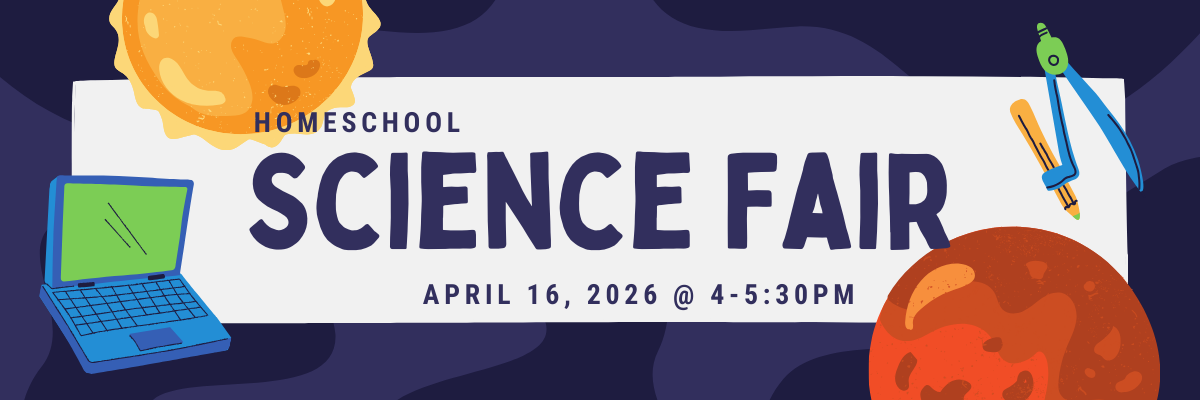
- Thursday, April 16, 2026 from 4-5:30pm the Science Fair will be open to the public for viewing.
- Complete and submit registration by March 9th.
- Students may set up on the day of April 16th from 3-4pm.
- Robey Memorial Library will provide:
- A table covered in a white tablecloth for displaying science.
- Cookies & lemonade for community visitors.
- A table covered in a white tablecloth for displaying science.
- Robey Memorial Library asks that participants register in advance to allow for appropriate setup.
- Participants are encouraged to remain with their science projects to interact with the public. Possible questions asked may be: What have you research? Why have you asked this question? What was the result?
- Submissions:
- May be any science project.
- Must be appropriate for all ages.
- Must be able to be moved into & out of our Community Room by participant.
Age Recommendations:
1-3rd grade: What I Did and What I Learned
Younger elementary students explore a science topic that reflects their current interests then share what they did and what they learned in the process.
4-6th grade: Simplified Scientific Method
Older elementary students explore a topic more in-depth by creating a simple hypothesis and going through a simplified version of the scientific method.
7-8th grade: Scientific Method
Middle school students follow the scientific method; however, background research and future studies would be brief.
9-12th grade: All Portions, Including Research, Conclusions and Future Studies
High school students complete all portions of the process including in-depth research, conclusions, and future studies.
Scientific Method:
- Ask a question: How, What, When, Who, Which, Why, or Where?
- Research: Find the best plan to answer question without repeating past mistakes.
- Construct a hypothesis: Create an educated guess about how things work with a prediction of what you will test— “If __[I do this]__, then __[this]__ will happen.”
- Test your hypothesis: Do an experiment that tests whether your hypothesis is correct.
- Analyze your Data & Draw a Conclusion: If prediction incorrect, construct a new hypothesis based on experiment results or report how experiment supported your prediction.
- Communicate Results: Create a display board and/or report of your results.
Source: sciencebuddies.org